Summary: France has cut its government consulting spend by almost four-fifths since 2021, while Germany and the UK report their own figures on very different definitions. The totals can’t be ranked, but how each government builds expertise in-house and buys the rest can be compared.
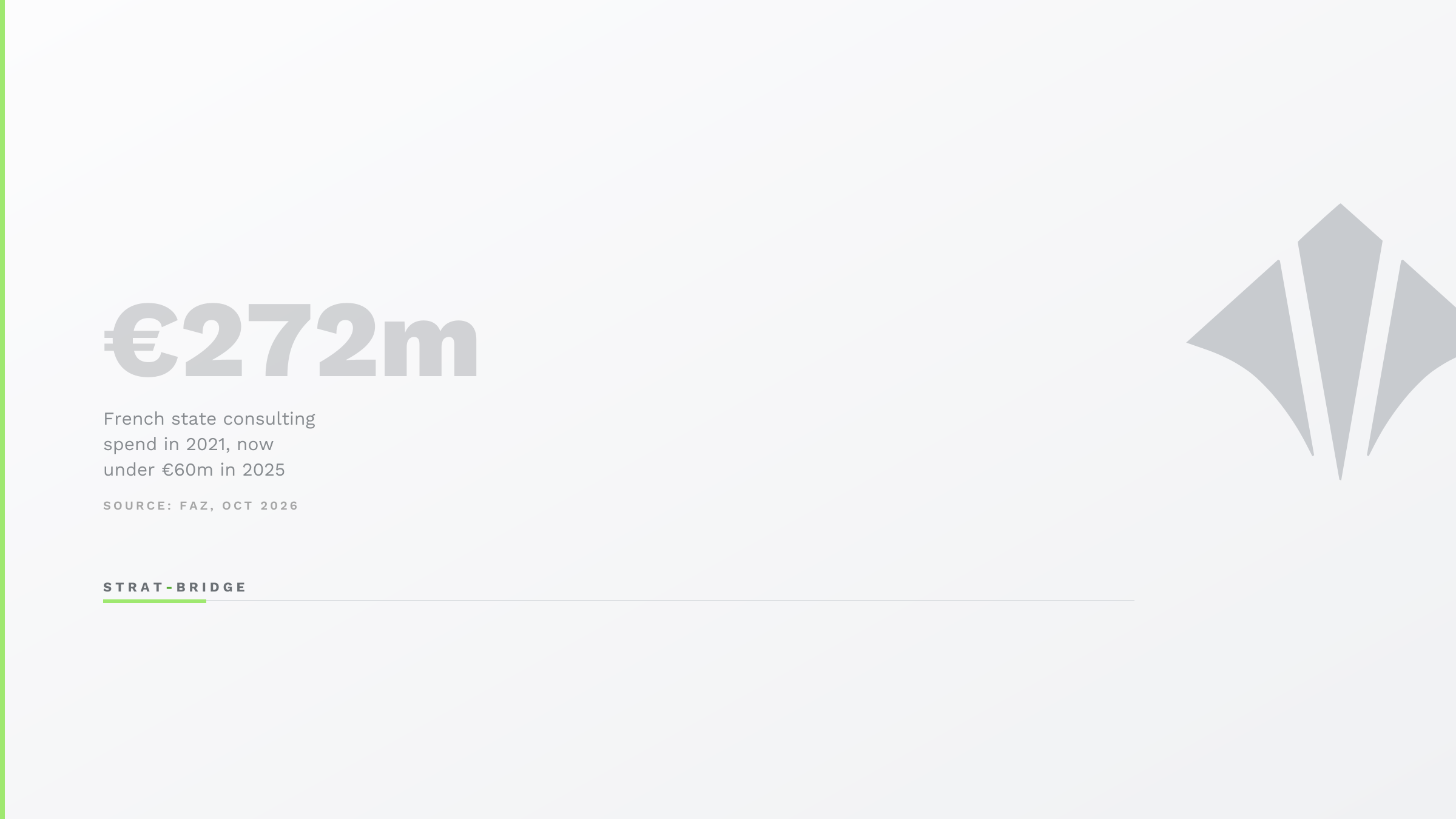
- France cut state spending on outside consultants from almost €272m in 2021 to under €60m in 2025, a figure that excludes IT consulting.
- Germany’s federal ministries reported €239m of external advice in 2023 and €182m in 2024, while UK central government reported £911m for the nine months to March 2025.
- France, Germany and the UK define and count consulting differently, so their government consulting spend totals cannot be compared as a league table.
- All three governments still buy outside expertise, and what really differs is how much they build in-house and how tightly they control the rest.
Government consulting spend is falling, or at least the reported numbers are.
Frankfurter Allgemeine Zeitung reported on 19 October that France has cut state spending on outside consultants from almost €272m in 2021 to under €60m in 2025. The figure comes from an annex to the French draft budget.
It’s a big drop, and it follows a political storm. In 2022 a French Senate inquiry found that ministries’ consulting spend had more than doubled during Emmanuel Macron’s first term, and criticised what it called opaque tendering.
The obvious next step is to line France up against the UK and Germany. That’s where it gets difficult, because each country counts something different.
The more useful comparison is how each government decides what expertise to build itself and when to buy it in. It’s the same question corporate clients are asking as more client capability moves in-house.
The real story in government consulting spend isn’t how much each country spends, it’s how differently they manage it.
France has cut government consulting spend by almost four-fifths
France’s state spending on outside consultants fell from almost €272m in 2021 to under €60m in 2025, according to the budget annex reported by FAZ. The figure covers legal, strategy and organisation work. IT consulting isn’t included.
The fall wasn’t a straight line. FAZ notes spending declined steadily from 2021, with a slight rise in 2024.
The Interministerial Directorate for Public Transformation (DITP) describes the approach as a “reinternalisation of consulting expertise”. Its head, Pierre Bouillon, who previously worked at BCG, told AFP the strategy had “borne fruit”.
The centrepiece is an internal consulting agency set up in 2024. It has about 60 staff and, according to the DITP, saves the state €11m a year.
The agency is only part of the story. The UK National Audit Office, in its review of how other countries manage consultants, notes that the French agency works with a dedicated central unit for buying consultancy, and credits the two with helping cut €191m of state consulting spend between 2021 and 2023.
There’s a fair counterpoint too. Macron argued that for one-off projects, hiring a consultant is cheaper than employing a civil servant. France’s public auditor, the Cour des comptes, didn’t object to outsourcing in principle either. Its 2023 review of state consulting asked for more selective use and stronger in-house skills, and put consulting at just 0.04% of state outlays.
Germany reports falling spend on a narrower definition
Germany’s federal ministries spent €239m on external advice in 2023 and €182m in 2024, according to the Federal Ministry of Finance’s annual report to the Bundestag budget committee.
That definition is narrow. Set by the budget committee in 2021, it counts support work only where advice is the main element, so most IT delivery falls outside it.
It also covers the federal ministries and their agencies only. Spending by the 16 states and by local councils, where much of German public administration happens, isn’t included.
Germany’s federal audit office, the Bundesrechnungshof, reported in June 2025 that this spending had risen 39% between 2020 and 2023. It also found that many IT services had dropped out of the reporting, and that there was still no strategy to reduce reliance on outside advice.
Germany’s structural answer is PD – Berater der öffentlichen Hand, a publicly owned consultancy with around 1,250 staff. Its shareholders include the federal government, the states and municipalities, and they can commission it directly without a tender.
The coalition agreement of Friedrich Merz’s government promises to cut spending on external advisers across every ministry, with no figure attached. Yet on 31 March 2026 the Federal Ministry for Economic Affairs and Energy tendered a framework for strategic top-management consulting for its leadership, covering up to 9,000 hours a year for four years.
UK government consulting spend is the hardest to read
UK central government reported £911m of consultancy spending between July 2024 and March 2025, excluding the NHS, against plans of about £1.5bn. The figures, set out in a Cabinet Office letter to MPs in January 2026, come from departmental forecasts and are not official statistics.
The UK definition is broad. The Cabinet Office counts help with digital transformation as consultancy, which France and Germany largely leave out.
The National Audit Office, Parliament’s spending watchdog, said in November 2025 that government lacks a clear picture of what departments spend on consultants. In its review, the main data sources differed by an average of £270m a year.
The wider public sector figure is bigger again. Tussell, which tracks public procurement, put UK public sector management consultancy at a record £3.7bn in 2024/25.
The UK’s controls have swung back and forth. Central spend controls were withdrawn in 2023. In November 2024 the government brought in ministerial sign-off for consultancy over £600,000 or longer than nine months, and departments now also have individual limits from the 2025 Spending Review.
MPs on the Public Accounts Committee have since warned that some spending may simply be reclassified as professional services.
Why government consulting spend figures don’t compare
Government consulting spend figures for France, Germany and the UK can’t be ranked against each other, because each country defines and counts consulting differently.
France leaves out IT consulting. Germany leaves out most IT delivery and everything spent by the states. The UK counts digital transformation, and its own auditor says departments classify consultancy inconsistently.
France’s own numbers show how much definitions matter. When the Cour des comptes included IT, French state consulting for 2021 rose from about €234m to €890m.
The time periods don’t match either. The UK figure covers nine months, while the French and German figures cover calendar years.
Put those numbers in a league table and you get a neat ranking, not a real comparison.
Put those numbers in a league table and you get a neat ranking, not a real comparison.Ben Appleton, Strat-Bridge
How France, Germany and the UK build expertise in-house
France, Germany and the UK have each tried to build consulting capability inside government, with very different results.
France’s model is small and recent. The agency has about 60 people and has run since 2024, paired with central control over buying.
Germany’s PD is older and much larger. It was set up in 2008 and works as a consultancy owned by its public clients.
Its defence ministry has a second one. BwConsulting, wholly owned by the federal government, has advised the ministry and the Bundeswehr since 2000.
The UK tried and stopped. The Government Consulting Hub was announced in 2021 and closed at the end of January 2023. The National Audit Office notes it was closed partly to reduce civil service headcount, and Cabinet Office permanent secretary Alex Chisholm later told MPs the plans had proved “too difficult”.
Australia offers another version. It set up its own unit, Australian Government Consulting, in 2023, which the National Audit Office reports at 32 staff.
None of these units replaces the market. They change how much governments buy, and how carefully.
Demand for outside advice in government hasn’t gone away
France, Germany and the UK are all still buying outside expertise, and the officials who buy it say much of it is worth it.
In the National Audit Office’s 2025 survey of officials who commission consultants, 86% said consultants made a valuable contribution. The sample was small, 48 people, but it reflects the view of the buyers.
The reasons are familiar. The National Audit Office points to skills gaps, and to pay and hiring restrictions that make it hard for departments to recruit specialists.
Defence is the clearest example. With European defence budgets rising, the profile I’m asked about most in this space speaks both languages, public and private. As one candidate put it, defence billions need spending well.
That’s a hiring point as much as a policy one. Europe’s defence pivot is reshaping consulting demand, and people who have worked on both sides of the table are part of the rise of the hybrid professional.
Judging government consulting spend on capability, not totals
The better test of government consulting spend is whether a government ends up more capable and getting better value, not how low the headline total goes.
The governments that get this right will build the expertise they need for the long term and buy the rest deliberately, with clear outcomes attached. That’s where the market is heading anyway, as consulting is pushed to own the outcome.
What they’ll still get wrong is treating a falling number as proof of progress. A lower total only tells you spend has fallen on one definition. I’d judge progress not on what each government spends, but on what it no longer needs to buy.
In English: Macron, McKinsey and Co.: France’s consultant scandal is occupying the judiciary
Read the original article
Further reading from Strat-Bridge
- Global Firms, Local ConstraintsCross-border friction is exposing the structural limits of the Big Four partnership model as AI and global client…
- How’s the Market? A Geopolitical QuestionConsulting firms still answer market questions with economic logic, even as geopolitics increasingly shapes strategy, talent, and capital…
- The McKinsey of AI: PE Goes In-HouseA PE-backed AI venture marks a structural shift: private equity is starting to internalise AI transformation rather than…
- Consulting Team Moves & Lift-Outs — how they workPartner-led team moves, practice builds and talent-led acquisition support for consulting firms across the UK, DACH and Europe.…
Work with Strat-Bridge
Strat-Bridge is a retained executive search firm placing Partner & Director-level leaders into strategy and management consulting firms across Europe.
Hiring senior consulting talent? Book a discovery call. Exploring your next leadership move? Join our leadership network.

Ben Appleton is the founder of Strat-Bridge, a specialist executive search partner to the management consulting industry. He works with global consulting firms and senior leaders across the UK, Germany, Switzerland, and beyond — helping them build capability at the Partner and Director level.
Connect with Ben on LinkedIn or email ben@strat-bridge.com.