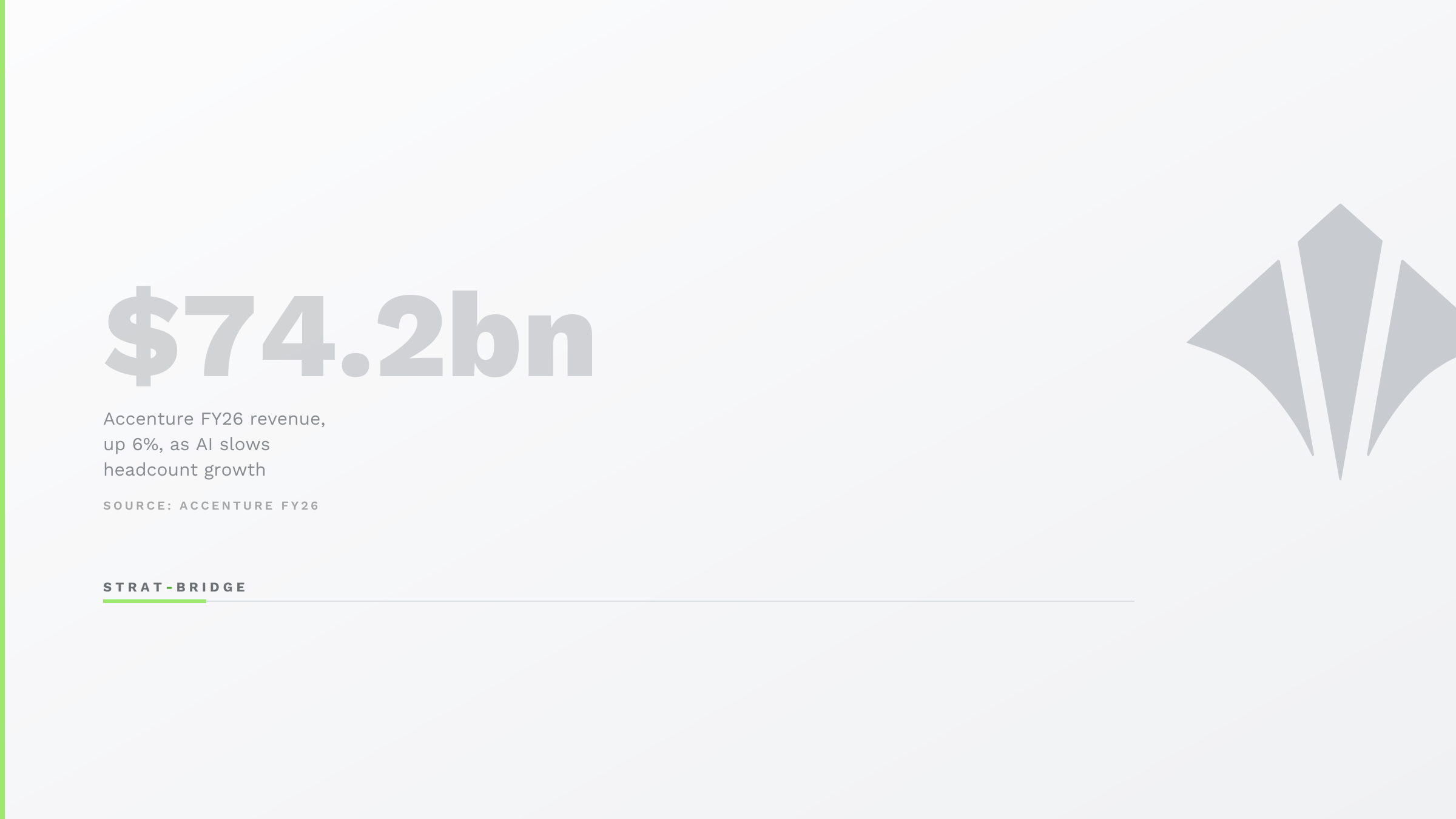
Summary: Accenture grew fiscal 2026 revenue 6% to $74.2bn while saying AI will slow its headcount growth. For consulting, it is the clearest sign yet that growth and headcount are coming apart, and that senior hiring, the pyramid and pricing all have to change with it.
- Accenture’s fiscal 2026 revenue rose 6% to $74.2bn, and CEO Julie Sweet said AI will slow overall employee growth even as the firm keeps hiring graduates.
- Revenue per head, not headcount, is becoming the measure of consulting growth as AI lets firms grow without adding people at the same rate.
- Senior consulting hires are now judged on whether they can originate AI-linked work with clients, not on technical AI knowledge alone.
- The consulting pyramid is turning into a diamond, with fewer juniors, a stronger middle and pricing under pressure wherever work was billed by the head.
Accenture has just shown that consulting growth no longer needs consulting headcount growth to match it.
The firm’s shares jumped as much as 22% on 1 October 2026, their biggest one-day rise since listing, as manager magazin reported the day after. The results had beaten what the market feared.
Fiscal 2026 revenue rose 6% to $74.2bn, or 5% in local currency, according to Accenture’s fourth-quarter earnings release. Net income rose to $8.5bn from $7.8bn. New bookings in the quarter reached $22.2bn, against analyst expectations of around $20bn. Guidance for fiscal 2027 is 3-6% growth in local currency.
The headline read was that fears of AI destroying demand for consultants had been overdone. That’s the less interesting reading.
The line that matters came from Julie Sweet on the analyst call, as the Financial Times reported it. Overall employee growth will slow because of AI, even as Accenture keeps expanding entry-level hiring. “We are seeing an increase in revenue per person, which is what you would expect in part due to AI,” she told analysts.
Accenture still added more than 15,000 people in the final quarter and now employs around 814,000. This isn’t a story about shrinking. It’s a story about the ratio, and it moves on from the questions we raised in Accenture: big, bold, still hungry.
AI is breaking the link between consulting revenue and consulting headcount, and every firm will be judged on that ratio from here.
Consulting headcount and revenue are decoupling
Consulting revenue and consulting headcount moved together for decades, and Accenture’s fiscal 2026 results show that link loosening. More revenue meant more people, mostly junior, sold at a margin above their cost. The model rewarded firms that could hire, staff and bill at scale.
The link hasn’t broken completely. Accenture let staff carry unused holiday into the new year to finish client work before the fiscal year closed. Julie Sweet said it meant the firm had enough people to meet demand. Even the most AI-invested firm in the market still ran into a capacity wall.
Clients still need the work. Sweet said many are only starting with AI, and that most of Accenture’s growth still comes from building the digital core: data, platforms, governance and operating-model change. That work is substantial and it isn’t going away.
What changes is how it is delivered. Clients will expect smaller teams, faster cycles and results they can measure. The pressure falls on three parts of the consulting model: who firms hire at the top, what happens at the bottom, and how the work is priced.
AI origination is now the senior hiring bar
Consulting firms now expect Partner and Director candidates to originate AI-linked work with clients, not just understand AI. The pick-up in senior hiring we’re seeing across the UK and DACH is real, but it’s narrow and it has a specific shape.
Five of our recent senior briefs name AI, data or technology strategy explicitly. Every one pairs it with client access. None asks for an AI specialist who delivers. They ask for someone who can sell.
A year ago, AI credentials were a plus on a Partner CV. Now they’re a threshold. The question in a client briefing has shifted from “does this person understand AI” to “can this person originate AI work with our clients”.
Deep technical knowledge isn’t enough. As we set out in the new Partner model, the scarce leader combines sector depth, commercial judgement and implementation credibility. They turn AI into a credible client proposition, originate the work and tie it to an outcome the client’s CFO will recognise.
For firms hiring Partners and Directors, the pool is smaller than the job title suggests. A search that screens for technical depth finds plenty of candidates. A search that screens for AI-linked origination finds very few.
The consulting pyramid is becoming a diamond
The consulting pyramid is turning into a diamond because AI now absorbs much of the research and analysis that once needed large junior teams. One Big Four leader described the new shape to me as one partner, three senior managers and far fewer below.
The base of the pyramid existed to do production work. Off-the-shelf AI does a lot of that now, which is the shift we described as moving from leverage to judgement. Investors see it too. The outsourcing model built on thousands of low-cost offshore workers is under scrutiny, and Capgemini and Infosys have both been caught in recent sell-offs.
The partner and senior managers are still needed. The client still needs judgement and someone to steer them through the change. One partner told me 80% of the job is holding the client’s hand.
A diamond also needs more people in the middle who can run client work without a large team underneath them. That’s a different profile from a manager who runs a pyramid, and it’s why the manager role is getting harder. Firms hiring Directors and Principals should be testing for it now.
Graduate hiring continues, but the job changes
Accenture’s plan to keep expanding entry-level hiring sounds like a contradiction of slower headcount growth, but it isn’t. The question isn’t whether firms hire graduates. It’s what those graduates do, how they learn and how many layers the model can support.
Juniors learned the craft by doing the production work: building the model, writing the first draft, sitting in the room. If AI takes the production work, the apprenticeship goes with it. We’ve written about how the apprenticeship model is changing, and why graduate salaries have stayed flat while firms work it out.
Automate routine work without rebuilding how people develop, and you improve this year’s margin at the expense of the next generation of Partners.
There’s a second risk. One senior leader warned that if firms stop building capability in their people, clients will simply do the work themselves. The firms that get this right will give juniors client contact sooner, smaller teams and more responsibility per head.
Consulting headcount no longer sets the price
Consulting pricing built on headcount is under pressure because clients now expect AI to cut the cost of the work. One partner told me clients now open with a simple line: you have AI, so it should cost a tenth.
His answer was just as simple: it doesn’t take a tenth of the time. AI removes parts of the work, such as first-pass analysis. It also adds new work: orchestrating tools, checking outputs, explaining what the machine got wrong.
Both sides have a point. The early analytical phases of a project – the diagnostic, the baseline, the initial transparency work – are getting harder to bill at traditional rates. The work that drives a decision and carries it through implementation is holding its value.
The split is already visible inside firms. One leader described protecting premium strategy rate cards while running a 50-person implementation team at a blended €800 a day. Same firm, two price points, two different businesses.
Day rates built on junior hours sit on a shrinking base. Fees tied to outcomes, or to senior judgement, sit on a growing one. Accenture’s rising revenue per person is an early sign of which way the arithmetic is moving, and it’s why we keep saying watch how firms get paid.
A firm that talks about AI-enabled delivery but still prices by the head hasn’t changed its model.
A firm that talks about AI-enabled delivery but still prices by the head hasn’t changed its model. It has changed its marketing.Ben Appleton, Strat-Bridge
Partner moves are becoming team moves
In a diamond-shaped consulting firm, a Partner who moves with two or three trusted senior managers brings a working delivery unit, not just a client list. When revenue stops scaling with headcount, it scales with the people who originate the work and the small teams that deliver it.
Expect more senior moves to be structured that way. We’ve long argued that the team move is consulting’s fastest growth lever, and slower headcount growth makes it more so.
The firms that can absorb a small team quickly and put it in front of clients within months will win more of these moves. The ones that treat every senior hire as an individual will lose them.
What slower consulting headcount growth means for firms
Consulting firms that win from slower headcount growth will treat senior hiring as their main growth lever, redesign the middle for leaner teams and move pricing away from the head. One Partner hire matters more than it did three years ago, and getting it wrong costs more too.
The firms most exposed aren’t the ones clients expect AI to replace. They’re the ones still hiring as if growth means more people, and still pricing as if clients can’t see the difference.
Read the original article
Further reading from Strat-Bridge
- AI Isn’t Killing Consulting – But It Is Killing the Old Hiring ModelAI is transforming how consulting firms hire and develop talent. The traditional pyramid model is shrinking as automation…
- Consulting’s Ladder Is NarrowingConsulting’s career ladder is narrowing, not collapsing. Entry-level hiring is slowing, partner promotions are tightening and AI is…
- Organic Consulting Growth Hits the CeilingThe Grant Thornton and Cinven deal highlights why organic growth is hitting a ceiling in consulting, and why…
- Consulting Team Moves & Lift-Outs — how they workPartner-led team moves, practice builds and talent-led acquisition support for consulting firms across the UK, DACH and Europe.…
Work with Strat-Bridge
Strat-Bridge is a retained executive search firm placing Partner & Director-level leaders into strategy and management consulting firms across Europe.
Hiring senior consulting talent? Book a discovery call. Exploring your next leadership move? Join our leadership network.

Ben Appleton is the founder of Strat-Bridge, a specialist executive search partner to the management consulting industry. He works with global consulting firms and senior leaders across the UK, Germany, Switzerland, and beyond — helping them build capability at the Partner and Director level.
Connect with Ben on LinkedIn or email ben@strat-bridge.com.